A spa menu calls it a signature treatment. In Morocco it is closer to a weekly errand — and every ingredient on that menu comes from a specific valley, harvested in a specific month.
The first thing to understand about the Moroccan hammam is that it is not a treatment. It is infrastructure. Almost every neighborhood in Marrakech has one, usually tucked beside the bakery and the mosque because all three historically shared a furnace, and most families go weekly. Children are scrubbed there. Brides are prepared there. Arguments are settled there. The version sold in palace spas is a real and often extraordinary thing, but it is a translation, and knowing the original changes what you get out of it.
The second thing worth knowing is that the ingredients are not decorative. Rose, argan, ghassoul clay and olive-based black soap are not a themed collection assembled by a marketing department — they are four agricultural products from four distinct regions of Morocco, each with a harvest season, a cooperative structure and a quality range that runs from remarkable to adulterated. Here is what they are, where they come from, and where in Marrakech to meet them properly.
How the ritual actually works
A traditional hammam is a sequence of vaulted rooms, each hotter than the last, heated by steam rather than dry air. You move inward, sit, and let fifteen or twenty minutes of heat do the work that no product can do: opening the skin. Rushing this step is the single most common mistake, and it is why a hurried version can feel underwhelming no matter what it cost.
Savon beldi comes next — a soft, dark, olive-based soap with the texture of a thick paste. It is spread over the whole body and left for several minutes. It does not foam and it is not meant to. Its job is to soften the outermost layer of skin so that the kessa, a coarse dark exfoliating mitt, can take it off. This is the part nobody prepares you for. A skilled kessala works briskly and without ceremony, and the grey ribbons that come away are genuinely startling the first time. It is also the reason people leave a hammam feeling recalibrated rather than merely relaxed.
Ghassoul follows. The clay is mixed with warm water, sometimes with rose water or a little argan oil, and applied as a mask to the body and hair. It draws out oil without stripping, which is why it has been used on hair for centuries in a country where soap was expensive. Then a long cold rinse, argan oil to close, and mint tea in the resting room. Done properly the whole sequence takes ninety minutes, and the last twenty are non-negotiable: dressing and leaving immediately undoes a good deal of it.
The four ingredients, and where they come from
|
Ingredient |
Origin |
Season and notes |
|
Damask rose |
Kelaa M’Gouna, Dades Valley |
Harvested by hand at dawn, late April to May. Rose festival in May. |
|
Argan oil |
Souss valley and the Arganeraie, near Essaouira and Agadir |
Pressed year-round; cosmetic oil is cold-pressed and pale, culinary oil is roasted and dark. |
|
Ghassoul clay |
Moulouya valley, eastern Middle Atlas |
Mined in seams, sun-dried in flakes. Naturally saponifying. |
|
Savon beldi |
Olive-growing regions, including the Haouz around Marrakech |
Olive pressing runs autumn into winter; soap is made year-round. |
The rose is the one that surprises people. Rosa damascena grows in hedgerows along the irrigation channels of the Dades Valley, at altitude, roughly five hours from Marrakech, and the harvest is short — a few weeks from late April, picked before sunrise because the oil content falls as the day warms. It takes several tons of petals to produce a kilogram of absolute, which is why genuine rose oil is priced like a precious metal and why most of what is sold as rose in spas is rose water, a distillation byproduct. Rose water is not a lesser thing; it is simply a different one, and it is the form Moroccan households actually use.
Argan comes from the opposite corner of the country, the semi-arid southwest, where the argan tree grows nowhere else on earth and the groves are a UNESCO biosphere reserve. Most production runs through women’s cooperatives, which is not a marketing detail — it restructured rural incomes across the Souss over three decades. The distinction that matters to a buyer is processing: cold-pressed cosmetic oil is pale and faintly nutty, culinary oil is roasted and unmistakably toasted, and anything odorless has been deodorized industrially.
Ghassoul — sometimes written rhassoul, from the Arabic for washing — is a stevensite clay mined only in the Moulouya valley. Unlike kaolin or bentonite it contains natural saponins, so it lathers slightly and cleans without detergent. It is sold in brown flakes that look like broken pottery and dissolve into a silky grey mud. Pre-mixed ghassoul pastes with added fragrance are a tourist product; the flakes are what is used at home.
Four ways to do it, and what each costs
The choice is less about budget than about what you want from the afternoon.
|
Type |
Indicative price |
What it is |
|
Neighborhood hammam |
15–30 MAD entry, plus 50–120 MAD for a gommage ($1.50–12) |
Bring or buy your own kit. Communal, gender-separated, no English. The original. |
|
Riad or Medina hammam |
350–700 MAD ($35–70) |
Private or semi-private room, full ritual, staff who will guide a first-timer. |
|
Palace spa |
1,200–2,500 MAD ($120–250) for the signature hammam |
Architecture, product houses, and a level of execution that is genuinely world-class. |
|
Fully private spa |
From roughly 4,000 MAD ($400) for exclusive use |
A spa suite or a whole hammam taken privately, or therapists brought to your villa. |
The neighborhood hammam is an experience rather than a service, and it is worth doing once if you are comfortable with communal bathing and traveling with someone who can navigate it. The riad hammam is where most first-time visitors should start: the full sequence, unhurried, with someone explaining each step. The two tiers above that deserve more detail, because Marrakech is unusual in having several of the best hotel spas in the world within a few kilometers of each other.
Inside the palace spas
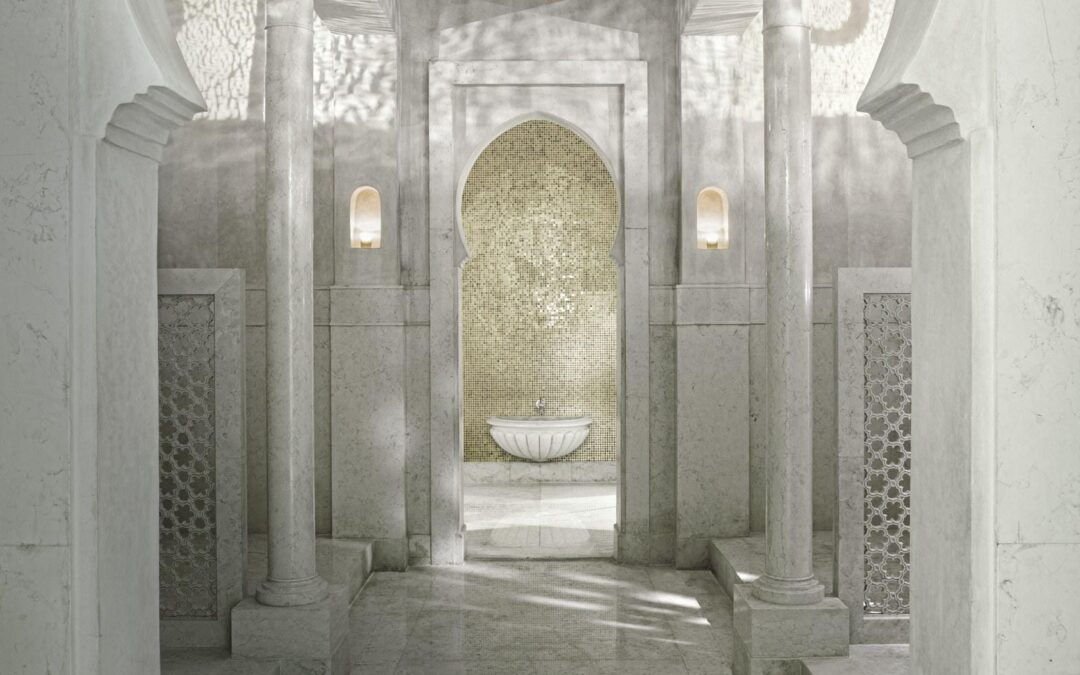
Vogue’s 2026 global spa guide placed a Marrakech property among the hundred best in the world, which is less surprising when you see how much square footage these hotels devote to bathing. Three are worth knowing, and all three take non-resident bookings, which means you do not need to stay at a palace to use one.
Royal Mansour
The spa reopened in an expanded form in 2021 and occupies its own palatial complex at the edge of the estate — roughly 27,000 square feet, entered through an atrium of white Moorish ironwork that looks like lace and is the single most photographed interior in the city. There are ten treatment rooms, three spa suites, a nail salon run by Bastien Gonzalez, and a 22-meter indoor pool under a glasshouse shaped as a Moorish arch. The signature hammam rituals are built around different regions of Morocco; the Valley of the Roses version wraps you in linen with rose water and argan and is the one to ask for. Expect somewhere around $200–250 for the full sequence.
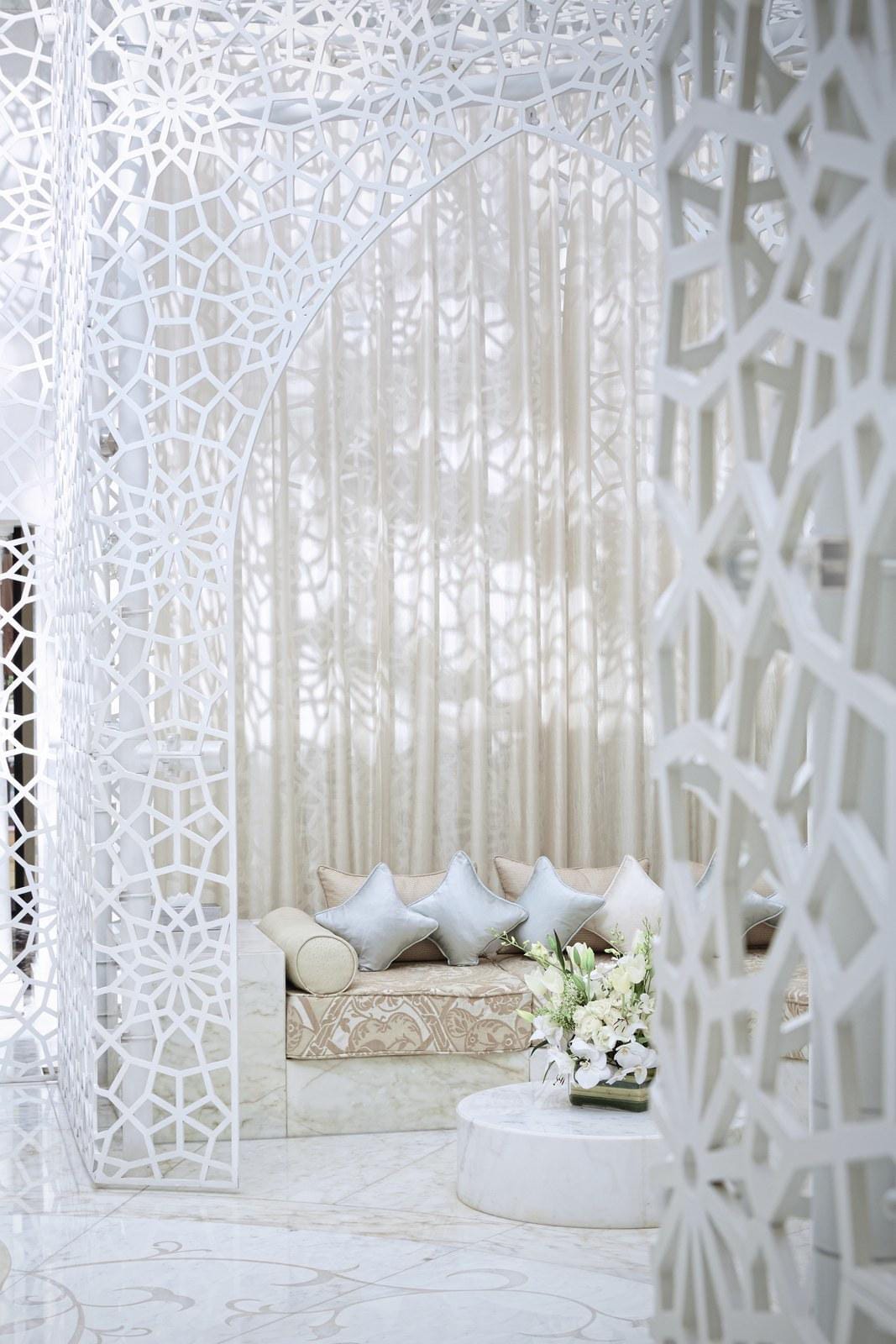
The white ironwork atrium at the Spa Royal Mansour. Photo: Royal Mansour Marrakech.
La Mamounia
Two and a half thousand square meters, renovated in 2023, and the most theatrical of the three — Jacques Garcia’s Arabian Nights staging, ten treatment cabins including doubles, a heated indoor pool, jacuzzi, and a barber and hair salon. Crucially it has two traditional hammams, separated by gender in the Moroccan manner, plus a third private one. The product houses on the menu are Valmont, Augustinus Bader and marocMaroc, the last being a Moroccan line worth seeking out. The traditional ninety-minute hammam sequence typically runs around $120–150, and couples’ slots book out two to three days ahead from October to April.
Es Saadi
The largest of the three at 3,000 square meters, arranged around a century-old eucalyptus, with a 1,000-square-meter solarium terrace above it. Es Saadi runs two distinct spas — the Oriental Spa at the hotel and the Palace Spa at the palace — and the Palace Spa is the one with the Oriental Thermae hydrotherapy circuit, balneotherapy rooms, Vichy showers, private Moroccan hammams and a VIP spa suite. It is the most resort-like in feel and the most generous with wellness day passes for non-residents. A fifty-minute massage sits around 1,100 MAD.
When you want it completely private
The fully private tier is the least advertised and, for a lot of travelers, the most interesting. It takes three forms.
The first is a private spa suite inside a palace: a self-contained apartment with its own hammam, double treatment room, jacuzzi and relaxation area, taken for a half-day by one couple or one family. Royal Mansour’s spa suites come with their own hammam and plunge pool; La Mamounia operates a dedicated private spa area with hammam, double cabin and jacuzzi; Es Saadi’s Palace Spa has a VIP suite. Nobody else passes through while you are in it, and hair and nail services can be brought in.
The second is privatizing a small riad spa outright. Several Medina riads with three or four treatment rooms will close to other guests for a few hours, which for a group of six or eight friends often costs less per person than the palace equivalent and feels considerably more Moroccan. This is the option most people do not know exists, because it is arranged by phone rather than sold on a website.
The third is bringing the spa to the house. If you are renting a villa, therapists, a portable hammam tent, and the full product line can come to you, which changes the arithmetic entirely for a family or a group traveling together. It is also the form that suits anyone uneasy about undressing in an unfamiliar setting. A number of the private wellness experiences in Marrakech are built this way, pairing an in-villa hammam with a dinner cooked in the house the same evening.

A private alcove in the spa atrium. Photo: Royal Mansour Marrakech.
One practical note across all three: the good private arrangements are made by phone or through whoever manages your stay, and they are almost never bookable online. If a property’s private spa does not appear on its website, that is not evidence it does not exist.
Practical notes before you go
Wear disposable or old underwear rather than a swimsuit; in a traditional hammam nobody goes fully nude, and lycra does not survive the scrub. Do not shave or wax in the twenty-four hours beforehand, and give it another day afterward — freshly exfoliated skin is genuinely raw. Drink water before and after, because ninety minutes of steam dehydrates more than it feels like it does. And if you are pregnant, or have cardiovascular or blood-pressure conditions, check with your doctor first; the heat is considerable and prolonged.
In a public hammam, bring your kit in a plastic bucket — soap, ghassoul, kessa glove, a comb, a towel and flip-flops. Most entrances sell all of it for a few dirhams if you arrive empty-handed. Tipping the kessala is standard, roughly 20 to 30 percent of the gommage price, in cash. In the palace spas, service is usually included and an additional tip is discretionary.
On timing: if the rose is what draws you, build the trip around late April or May. The harvest in Kelaa M’Gouna is one of the few agricultural events in Morocco genuinely worth reordering an itinerary for, and the distilleries in the Dades run at full tilt for a fortnight.
It sits naturally on the route between Marrakech and the desert, so it costs a detour rather than a separate trip — the kind of thing that works well as part of a set of custom activities and tailored experiences in Morocco built around a harvest date rather than a fixed departure.

The indoor pool at the Spa Royal Mansour. Photo: Royal Mansour Marrakech.
Taking it home
This is where Marrakech is unusually generous. A tub of savon beldi costs 20–40 MAD ($2–4) and lasts months. A block of ghassoul flakes is 15–30 MAD. A kessa glove is under two dollars. A hundred milliliters of genuine cold-pressed argan oil from a cooperative runs 120–200 MAD ($12–20), and a bottle of rose water 25–60 MAD. For the price of one treatment at home you can carry back the entire ritual several times over.
Two things to check. On argan, look for a cooperative name and a pressing date, and be suspicious of anything odorless or sold in a clear plastic bottle on a market table in full sun. On rose water, the ingredient list should read as one line. Anything containing parfum or fragrance is scented water, and it will smell lovely and do nothing.
What you cannot bring home is the pacing — the twenty minutes of doing nothing in the heat before anything begins, and the twenty at the end before you are allowed back into the day. That part is the actual treatment. The rose and the clay are simply what Morocco happens to have on hand.
About the author — Benoît Cordonnier is the founder of Morocco Luxury Highlights, a private travel company based in Marrakech specializing in bespoke itineraries, private villa stays with full household staff, and desert journeys.
Spa prices and facilities are indicative, reflect published rates in 2026, and change seasonally; confirm directly with the property. Converted at approximately 10 MAD to the US dollar. This article is informational and not medical advice.